


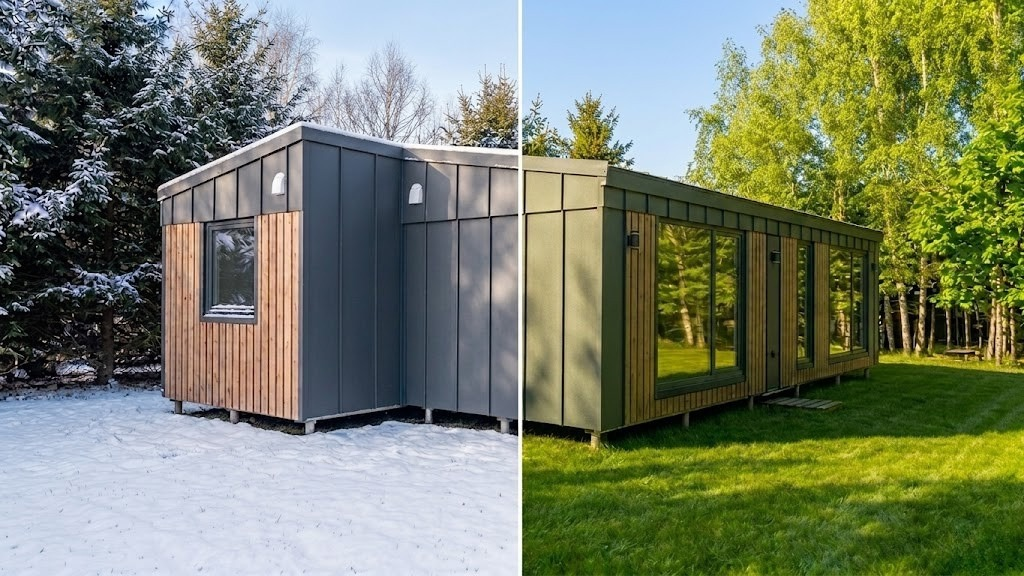
An all-year-round home and a recreational home differ primarily in the standard of preparation for use. We design the all-year-round variant with everyday comfort in mind for 12 months, while we adapt the recreational variant for leisure, weekend getaways, and periodic use of the home.
This difference affects the construction, scope of insulation, selection of installations, and finish specification. Therefore, when choosing, it is worth looking not only at the floor area or the appearance of the building form, but above all at whether a given variant corresponds to how we actually want to use it.
All-year-round or summer modular home – what does the choice depend on?
We choose an all-year-round modular home when the building is to serve as regular accommodation for 12 months. A recreational home works well where the priority is a comfortable space for leisure and use adapted to a seasonal or occasional rhythm of life.
It is not, therefore, a simple division into a “better” and “worse” variant. It is about whether the home is to be a permanent place of residence, or rather a comfortable place for trips, relaxation, and shorter stays.
The most important differences between an all-year-round and a recreational modular home
The biggest difference concerns the thermal standard of the building. This affects comfort in winter, the heating method, and everyday use of the home.
| Area | Recreational variant | All-year-round variant |
| Purpose | Leisure, periodic stay, second home | Regular use throughout the year |
| Construction and insulation | Selected for lighter use | Prepared for higher thermal comfort |
| Heating | Selected for recreational character | Better foundation for permanent winter use |
| Energy efficiency | Sufficient for a leisure home | Important for everyday living |
| Type of investment | Home for a recreational plot or trips | Home for permanent, all-year-round living |
Construction and insulation – this is where the difference is most noticeable
How a home behaves in winter is primarily determined by the layers of partitions, insulation thickness, and construction method. In our homes, we work with certified Scandinavian timber and Rockwool stone wool insulation, because these elements have a real impact on comfort of use.
This is clearly visible in the example of the Family 70 m² model. In the recreational configuration, we provide 10 cm wall construction and 10 cm Rockwool. In the all-year-round configuration, the same model receives 15 cm wall construction and 20 cm Rockwool. This is not a cosmetic change, but a difference that translates into how the building performs and noticeable comfort throughout the year.
In the all-year-round variant of Family 70 m², we also provide 20 cm of insulation in external walls and 25 cm in the roof. This is where it is best to see how important thermal insulation is in a home that is to provide comfort all year round.
The final result is determined not by one element, but by the entire system: appropriately selected mineral wool, proper layers, and a well-thought-out partition construction. These affect comfort in winter, durability, and everyday use of the home.
Heating and winter comfort – which variant better meets all-year-round use?
If the home is to be used regardless of the season, heating and energy efficiency become one of the main selection criteria. That is precisely why, with an all-year-round home, not only the heat sources themselves are more important, but also the quality of joinery, tightness, and partition insulation.
In the all-year-round variant, we focus on solutions that genuinely enhance the comfort of everyday home use: triple-glazed joinery, preparation for heat recovery ventilation, air conditioning with heating function, and underfloor heating based on heating film. In the additional equipment, we also provide a Panasonic heat pump with water underfloor heating.
This scope best shows what distinguishes an all-year-round home from a recreational one. In an all-year-round home, it is not only the floor area or layout that matters, but also comfort in winter, predictability of use, and solutions that work on a daily basis.
In the recreational variant, the emphasis is distributed differently. Here, the simplicity of the investment, quick completion, and good adaptation of the home’s parameters to how we will actually use it are important.
Why do the roof, wool, and ventilation matter so much?
The thermal comfort of a home is not determined by one element, but by the way in which construction, insulation, joinery, ventilation, and heating installation work together. If these elements are well selected, the home maintains temperature better and works more predictably in winter.
That is precisely why appropriate layers in the walls and roof are so important in an all-year-round home. They are primarily responsible for whether the interior will simply be pleasant regardless of external conditions.
Not every home needs to be all-year-round from the start
Before making a decision, it is worth considering how we actually want to use the home, instead of assuming that it is better to choose a higher standard right away.
If the home is to be a place for weekends, holidays, occasional remote work, or a second address outside the city, the recreational variant may be a very sensible choice. If, however, from the beginning we think of the home as an everyday living space, the all-year-round variant provides greater comfort and a better foundation for permanent use.
This is clearly visible in our range through the cross-section of models – from smaller houses to larger family designs. You can also adapt the modular home model and finish specification to your own needs: from a closed shell state to a turnkey variant. This makes it easier to compare specific house designs and check which layout best corresponds to the planned method of use.
When is it worth choosing the recreational variant?
The recreational variant works best when the home is to be a comfortable place for relaxation, not the primary place of residence throughout the year.
- when we are building a home on a recreational plot,
- when we plan weekend or seasonal stays,
- when we care about quick completion and a simpler investment model,
- when we want to properly adapt the scope of the home to the actual method of use.
When is it better to opt for an all-year-round modular home?
We choose the all-year-round variant when from the beginning we assume regular use of the home regardless of the season and want to maintain high comfort also in winter.
- when the home is to serve for everyday living,
- when stable temperature and higher thermal comfort are important,
- when we are thinking about more advanced heating solutions,
- when we view the home as a long-term investment.
What is the best basis for a decision before starting an investment?
First, it is worth answering three questions: how often we will use the home, whether we want to live in it in winter, and what level of comfort we want to achieve. Only then is it worth choosing a specific model, finish specification, and scope of installations.
A choice that makes sense even after several seasons of use
An all-year-round and recreational home differ primarily in the standard of preparation for use during a larger part of the year, and the thermal insulation of partitions says the most about this. It is precisely this, together with the construction of walls, roof, and selection of heating solutions, that determines comfort in winter, temperature stability, and whether the home is to be a place for occasional relaxation or for regular living throughout the year.
At ModEraHouse, we attach great importance to the arrangement of layers, the quality of structural timber, stone wool insulation, and solutions that genuinely affect the subsequent use of the home. It is not about always choosing the all-year-round variant, but about selecting it honestly according to lifestyle, plot, and expected standard. This is where we help most often: we compare the recreational and all-year-round variant on a specific model, indicate where the difference will be truly noticeable, and select a solution that makes sense not only at the purchase stage, but also after several seasons of use. If you are at the selection stage, the most valuable thing is to translate this decision into a specific model, layout, and finish specification.
FAQ
Is a recreational modular home suitable only for summer?
No. The recreational variant does not automatically mean a home exclusively for a few summer weeks. It rather means a different design starting point and a different adaptation of parameters to the method of use than in the all-year-round variant.
What most strongly distinguishes the all-year-round variant from the recreational one?
They are most distinguished by construction, scope of insulation, and preparation of the home for operation in all-year-round conditions. It is precisely these elements that affect comfort in winter and everyday use.
Can a heat pump be used in an all-year-round modular home?
Yes. In the all-year-round variant, we can provide a Panasonic heat pump with water underfloor heating as an element of additional equipment.
Why does insulation matter so much when choosing a variant?
Because it largely determines thermal comfort, the building’s performance in winter, and how the home maintains internal temperature. With all-year-round use, this aspect is of key importance.
What is the best starting point for choosing a variant?
From determining the method of use of the home. When we know whether the home is to serve for leisure or for everyday living throughout the year, it is much easier to select the appropriate construction, standard, and scope of equipment.