


The phrase “turnkey modular home” sounds very specific: you choose a design, sign a contract, and receive a finished home. In practice, that’s exactly what it means – but only if this term represents a real scope of work, not just a general marketing slogan. Therefore, if you are planning to build a modular home, it is worth knowing from the outset what exactly the turnkey finish specification means and what you can expect from it.
For many people, this is currently the most convenient way to build a home. Instead of organizing subsequent finishing stages separately, supervising various teams, and prolonging the construction process, the entire investment can be completed much more efficiently. This is precisely why all-year-round turnkey modular homes are gaining increasing interest – especially among those who want to combine convenience, predictability, and modern construction.
At Moderahouse, the turnkey option represents a specific standard of completed projects, not a general label. It is a solution for those who want to receive a home at a high level of readiness and transition faster from decision-making to comfortable use of the building.
What is a modular home and what does this technology involve?
What is a modular home? It is a building constructed from prefabricated elements or ready-made modules, which are prepared in advance under controlled conditions, most often in a production facility or factory. Then, the finished parts are transported to the client’s plot, where the installation takes place. Such a prefabricated home allows for a more organized overall process than traditional construction carried out from scratch on-site.
This is precisely what modular technology entails. A large part of the work does not take place directly on the plot, so the construction site primarily becomes a space for installation and final works. This translates into greater predictability, shorter lead time, and less organizational chaos than with traditional home construction.
It is also worth remembering that not every modular home is simply a timber-frame house, although these terms are sometimes linked. Similarly, solutions such as modular buildings and container homes should not be equated, as they can differ in construction, purpose, standard, and comfort of daily use. A well-designed all-year-round modular home is a fully-fledged home for year-round living, not a temporary solution.
At Moderahouse, we create both smaller recreational models and larger all-year-round modular homes for families. This makes it easier to adapt the home to your lifestyle, planned budget, and how the finished space should look.
What does a turnkey modular home mean in practice?
Simply put, a turnkey modular home is a variant where you receive a building at a much higher level of readiness than in a shell and core or developer’s finish. This model of completed projects is designed to maximally simplify the entire investment and reduce the number of tasks that need to be organized independently after installation.
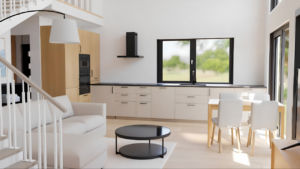
At Moderahouse, the turnkey variant includes not only the module itself and installation, but also a specific scope of finish specification and equipment. Depending on the model, the client receives, among other things, floor panels with skirting boards, Norwegian FIBO bathroom panels, installation of lighting fixtures, white bathroom installation, boiler installation, and bathroom equipment. The turnkey standard also includes high-quality materials, such as Norwegian FORESTIA One Step Ceiling panels.
This is why this option is so popular among people who do not want to start another stage of construction after receiving the home. In practice, this means fewer decisions, fewer teams to coordinate, and a faster transition from investment to daily use of the home.
How does turnkey modular home construction work?
Modular home construction begins with choosing the appropriate model and adapting it to the client’s needs. Not only the floor area matters, but also the functional layout, the building’s purpose, technical parameters, and the expected finish specification. At this stage, it is worth thoroughly analyzing the house design and checking what exactly the chosen completed projects variant includes.
The next stage is the preparation of prefabricated elements. It is precisely because they can be prefabricated off-site from the client’s plot that the entire modular home construction process becomes more predictable and organized. Then, the finished elements are transported to the site and installed. In practice, this means that building a home using modular technology looks completely different from a multi-month, traditional completed projects carried out in stages on a construction site.
From the client’s perspective, this is a huge difference. With classic home construction, one usually has to monitor the schedule, teams, and subsequent stages of work for a long time. In the case of a modular home, a significant part of the process is already pre-organized, so the whole thing proceeds faster and more conveniently.
What is included in the turnkey standard at Moderahouse?
This is one of the most important questions to ask before signing a contract. At Moderahouse, we offer three clear home handover standards: shell and core, developer’s finish, and turnkey. This allows you to match the scope of completed projects to your budget, desired finish level, and how much of the work you want to leave to us from the start.
In the highest standard, you receive a home with finished floors, a completed bathroom, installed systems, mounted lighting, a boiler, and bathroom equipment. In selected models, the standard also includes air conditioning installation with heating function and underfloor heating, and in larger completed projects, also a Panasonic heat pump and water underfloor heating.
Thanks to this, the turnkey variant at Moderahouse does not just mean “a home brought to some stage,” but a truly ready, refined space that allows for faster occupancy. This is especially important for those who want the entire construction process to be as organized and predictable as possible.
Turnkey home vs. developer’s finish – what’s the difference?
It is worth understanding this distinction well before choosing an offer. A developer’s finish usually means a home prepared for further finishing works. You already have a solid base, but there are still many decisions, orders, and organizational activities left on your side.
In the turnkey standard, this scope is much smaller. Instead of planning subsequent stages after handover, you receive a home much closer to daily use. This is a huge difference for people who simply want to move in faster, rather than spending months on another part of the investment.
Therefore, when comparing offers, it is not worth asking only how much a modular home costs. A much more important question is: what exactly do I receive for this price and what scope does the turnkey price cover. The price of a modular home alone, without context, does not say much.
Advantages of turnkey modular homes
The advantages of turnkey modular homes are best seen when we look at the entire investment, not just the installation moment. This is a solution for people who want to shorten the path from model selection to a finished home and not break down the entire process into many separate stages.
The main benefits include:
- shorter and more predictable modular home construction process,
- fewer tasks remaining on the client’s side,
- greater organizational convenience than with traditional construction,
- clearer division of work scope and costs,
- faster transition from design to home occupancy,
- ability to adapt the standard to individual needs.
For many clients, durability and quality of workmanship are also important. Well-designed modern modular homes are not a temporary solution, but a fully-fledged alternative to more traditional technologies. This is why all-year-round turnkey modular homes are increasingly chosen by people looking for a comfortable and modern way to own a home.
Disadvantages of modular homes – what to keep in mind?
To approach the topic fairly, it is also worth discussing the disadvantages of modular homes. Most often, however, they do not result from the technology itself, but from a mismatch of expectations to the scope of the offer or from comparing marketing slogans without checking the details.
The most common mistakes include:
- too general an understanding of the term “turnkey”,
- omitting what the offer actually includes,
- underestimating additional elements,
- lack of analysis of issues such as the foundation, installation, or transport of the modular home,
- comparing only the price, without comparing the scope.
Therefore, before signing a contract, it is worth checking not only the cost of the modular home, but also the exact scope of the turnkey standard – including heating, bathroom equipment, internal doors, lighting installation, and whether transport is calculated separately. These details determine whether the offer truly meets your expectations.
What to pay attention to before choosing an offer?
Regardless of whether you are interested in a small recreational model or a larger all-year-round modular home, it is worth analyzing the offer more broadly than just through the prism of price. The headline “turnkey” alone is not enough. What truly matters is what the standard actually includes and how the entire completed projects looks.
- Modular home design – check if the floor area, layout, and functionality meet your needs.
- Finish specification – make sure what exactly is included in the offer.
- Lead time – ask how long the preparation, installation, and handover of the home will take.
- Price scope – compare not only the cost, but also what the price of the modular home actually includes.
- Heating and installations – check what solutions are provided in the selected model.
- Additional costs – make sure whether transport, foundation, or other elements are included in the price.
- Formalities – ask about the documentation process and whether building permits are required for the chosen solution.
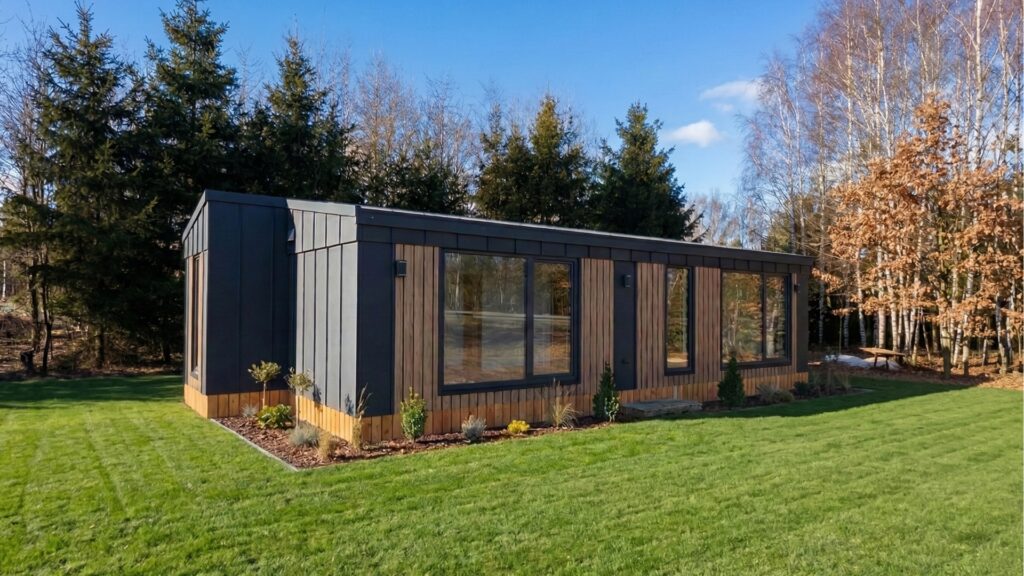
It is also worth seeing completed projects and checking how finished prefabricated homes look in practice. This is the best way to assess the aesthetics, quality of workmanship, and level of detail.
Summary
A turnkey modular home is not just a catchy slogan, but a specific model of completed projects designed to simplify the entire process and shorten the path to owning your own home. For many people, it is the most convenient way to build a home without months of organizational chaos, constant supervision of teams, and prolonged work on the plot.
The most important thing, however, is to always look at the offer holistically. What matters is not only how much an all-year-round modular home costs, but also what exactly the price includes, what the modular home design looks like, what the installation conditions are, and what scope the turnkey standard has. Only then can you consciously assess whether this solution will be the best choice for you.
If you want to check available models, compare handover standards, and see how our completed projects look in practice, view modular homes, visit completed projects and contact us via the contact form. We will help you choose a solution tailored to your needs and expected standard.
FAQ
Is a turnkey modular home ready for occupancy?
In practice, this variant leads to exactly that, but the exact scope must always be checked in the offer. The finish specification and what the package specifically includes are key.
How much does a turnkey modular home cost?
It depends on the floor area, design, standard, and scope of completed projects. If you are wondering how much a modular home costs, always compare not only the price, but also what the offer actually includes.
What to pay attention to before signing a contract?
Check the design, finish specification, price scope, lead time, installation, transport, and any additional costs. This is the best way to assess the real value of the offer.
What home handover standards does Moderahouse offer?
At Moderahouse, you can choose one of three handover standards: shell and core, developer’s finish, and the turnkey variant. This makes it easier to match the scope of completed projects to your budget, desired finish level, and how much of the work you want to leave to the contractor.
What exactly does the turnkey standard at Moderahouse include?
Depending on the model, the turnkey standard at Moderahouse includes, among other things, floor panels with skirting boards, bathroom finishing with FIBO panels, installation of lighting fixtures, white bathroom installation, boiler installation, bathroom equipment, and selected heating solutions such as air conditioning with heating function, underfloor heating, or a heat pump.